
Footnoting History
  • Home
  • About
  • Calendar
  • Archive
  • Teach
  • Donate
  • Shop
  • Contact
  • Home
  • About
  • Calendar
  • Archive
  • Teach
  • Donate
  • Shop
  • Contact
Search
Picture

Medieval Coroners

4/6/2024

6 Comments

 
Apple  | Audible |  Spotify  |  RSS  |  YouTube (captioned)
​
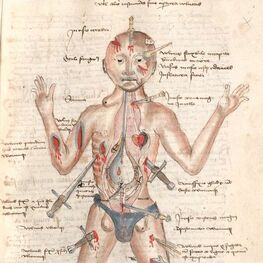
Medieval illuminated image of a man's body with knives stuck in to various places and types of wounds labeled
If you've watched any significant number of crime dramas you've almost certainly come across a coroner who was probably presented as an experienced medical examiner who, if the hero is lucky, has unearthed a key piece of evidence to solve the case. But did you know that coroners have been investigating death since the end of the twelfth century? Learn more right now on Footnoting History.

Host: Samantha
Help keep Footnoting History going, click here to find out how
​
Further Reading

Sara Butler, Forensic Medicine and Death Investigation in Medieval England, Routledge, (2015).

R.F. Hunnisett, The Medieval Coroner, Cambridge University Press, (1961).

Medieval Murder Maps, University of Cambridge.

Katharine Park, “The Life of the Corpse: Division and Dissection in Late Medieval Europe” Journal of the History of Medicine and Allied Sciences 50.1 (1995): 111-32.

Related Content

This episode is part of our True Crime Series.

​​Music: "Evening Melodrama" by Kevin Macleod (www.incompetech.com)
6 Comments
RT
4/7/2024 01:24:45 pm

Lovely, informative, well done

Reply
Will Witters
7/2/2024 11:13:47 am

I recently discovered your podcast and I'm clearly catching up, but I just finished this episode and want to take Samantha up on her offer to discuss more medieval jobs! Personally, I'd be down for a whole series!

Reply
Footnoting History
7/16/2024 04:14:57 pm

Thank you for this lovely comment! We are hoping to continue it. In August (you heard it here first) we are going to do one on medieval midwives with other occupations being discussed for the future!

Reply
Julie
8/17/2025 09:10:39 am

Very interesting. I read in a word etymology book that the word coroner comes from crowner or the coin that the deceased family paid to the king/coroner for his work. Is this true?

Reply
Will
8/18/2025 05:06:42 pm

From what I've read, the coroner originally saw to the financial interests of the crown (hence the name) and only later took on the role of investigating suspicious deaths, which eventually became the entire job.

Reply
Footnoting History
8/27/2025 06:44:04 pm

Samantha says, "My understanding is that the title coroner is shortened from the original Anglo-Norman title which was custos placitorum coronae (or guardian of the pleas of the crown). So while it is explicitly connected to the word crown, it is a reference to the administrative duties that the coroners had on behalf of the king rather than to a specific coin. Moreover, crowns were only introduced in 1551, whereas we can see coroners called by that title in the Magna Carta (1215)."


Leave a Reply.

Site Map

Home
Listen​
Calendar
Archive
Teach
​About
​Contact
Shop
Donate
 © 2013-2025 Footnoting History.  All rights reserved.
Footnoting History and the Footnoting History logo
are trademarks of Footnoting History, NY.

Footnoting History operates under a SAG-AFTRA
​Micro-Monetized Podcast Agreement.
Logo design by Alicia Disantis (https://38andkip.com/).
  • Home
  • About
  • Calendar
  • Archive
  • Teach
  • Donate
  • Shop
  • Contact